

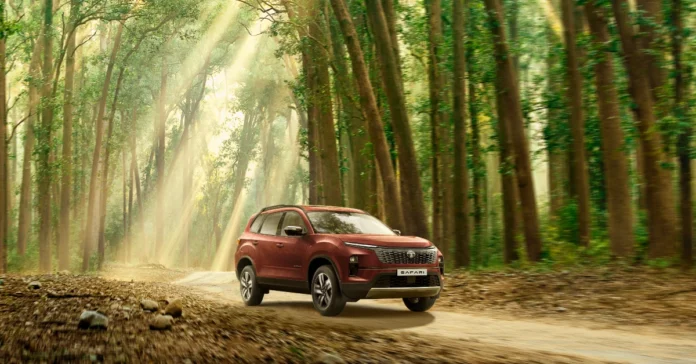

The Tata Safari EV is rumoured to launch in India around Diwali. It will be positioned above the Harrier EV, becoming Tata’s flagship all-electric offering in the country. The electric SUV has been spotted testing numerous times on Indian roads since 2023. It has been internally codenamed ‘Tayrona’. Upon launch, it will join the Tigor EV, Tiago EV, Punch EV, Nexon EV, Curvv EV, and Harrier EV in Tata’s electric catalogue.
Read Also: 2026 Mercedes-Benz GLS facelift breaks cover
Table of Contents
Tata Safari EV: What to expect?
The Safari EV will be underpinned by the same platform as the Harrier EV. This activ.ev+ platform is derived from Tata’s ICE architecture rather than being exclusively developed for EVs. Not much is known about the all-electric Safari’s exterior so far, but it will bear a similar look to its ICE model. It will borrow design elements from the Harrier EV as well, including the vertically stacked LED headlamps and LED DRLs. It will get a new design for its bumpers (front and rear), a closed-off grille, and a new look for the aero-optimised alloy wheels. The rear section of the two EVs will be close to identical.

Inside, the Tata Safari EV will borrow its layout from the all-electric Harrier. This means it will feature the 14.53-inch touchscreen infotainment system with Samsung’s Neo QLED automotive display. There will be support for wireless Android Auto and Apple CarPlay. Other features like digital key, smart card, remote key, built-in navigation, memory seating, rear headrests, centre armrest with cupholders, a voice-assisted panoramic sunroof, a dual-zone climate control, cooled storage, an air purifier, ambient lighting, and 65W wireless charging, will also be present on the electric SUV.

There will be no mechanical changes on the Safari EV either. It will borrow the electric powertrain and battery options of the Harrier EV. The all-electric Harrier is available in 2 battery pack variants – 65kWh and 75kWh. The 65kWh variants are powered by a single electric motor that’s mounted on the rear axle. This motor generates a maximum power output of 235hp. Meanwhile, the dual motor setup on the 75kWh variants churns out 390hp and 504Nm. These variants can go from 0–100 km/h in 6.3 seconds.

The two battery packs have a driving range of 538km and 622km, respectively. A 120kW DC fast charger takes the larger battery pack from 20% to 80% in 25 minutes. A 7.2kW AC charger takes it from 10% to a full charge in 7 hours. Meanwhile, a 15A plug point takes 29 hours to fully charge the battery pack.
Read Also: Hyundai Venue gets a 5-star safety rating from Bharat NCAP
Final Thoughts
Tata will reveal more information about the Safari EV as we get closer to launch. We expect it to fetch above Rs 22 lakh. It will rival the likes of the Mahindra XEV 9S, Maruti Suzuki e Vitara, and Hyundai Creta Electric.